Friday, 11 February 2011

Tierra del Fuego - Ushuaia

Sometimes this road is windy
We left Punta Arenas in gorgeous sunshine and had a relatively smooth ferry crossing over to Porvenir wondering where the famous Tierra del Fuegan wind could be. If anything we felt a bit cheated as we headed due east out of Porvenir, into the emptiness, we had read about 80km/hr Westerlies on very flat ripio terrain and had hoped to do some record breaking (or personal bests anyway), but the wind speed couldn't have been more than 20km/hr.

I've never worked out how other cyclists work out wind speeds, but I use a number of highly scientific techniques, all based around trying to cycle at the same speed as it. My favourite is the Flyaway Hair measure, where if you have an irritating wisp of hair in your face then the wind is faster than you are. Pob and I basically guess wind speed by checking the speedo when it feels completely still.

There's not much to see in this part of Tierra del Fuego
The wind picked up a little the following day but only to about 30km/hr. As there is't much else to do in this part of the world we set about record breaking on the way to San Sebastian. We managed our furthest ripio journey (63 miles), and furthest total mileage (64 miles) and longest time on the bikes (6 1/2 hours, plus two very long queues at Argentinian and Chilean immigration, not on the bikes).

The following day the wind was stronger (approx 40km/hr) and the landscape still wasn't terribly interesting, save for the huge expanse of it all, so we went for some other records on the smooth Argentinian tarmacked road on the way to Rio Grande. Our average speed over the 50 mile journey was 14.4mph. Pob was hoping to break his speed record but unfortunately there weren't any steep enough hills...

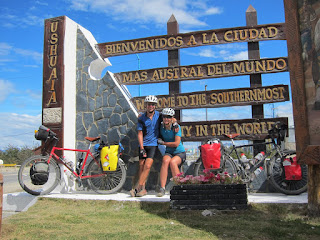
The weather and scenery significantly improved for our last 100km into Ushuaia and it was wonderful to have some gorgeous views for our final cycle of the trip. We also bumped into an English couple on bikes going the other way who it turned out were Andy, from Thorn, and his wife!  Andy designed our bikes and gave us some advice back in June when we visited the Thorn shop in Bridgewater so it seemed a fitting end to the trip to bump into him near Ushuaia.

So, we've arrived, and it feels great, but strange not to be thinking about the next day's road surface and wind and food and camping conditions; the only remaining challenge is to find some boxes big enough to take our bikes on the plane to Buenos Aires, and from there back home.


Saturday, 5 February 2011

Almost there now

We've just hopped on to a ferry from Punta Arenas, on the southern tip of mainland Chile, to Porvenir, in Tierra del Fuego. This is the start of the final leg of 500km through Tierra del Fuego to Ushuaia. We're slightly apprehensive about it having heard some of the horror stories from other cyclists of the winds, road conditions, and lack of any civilisation for at least the first 150km, but as we're going south we *should* at least have the benefit of the wind most of the way.
Pushing to Fitzroy

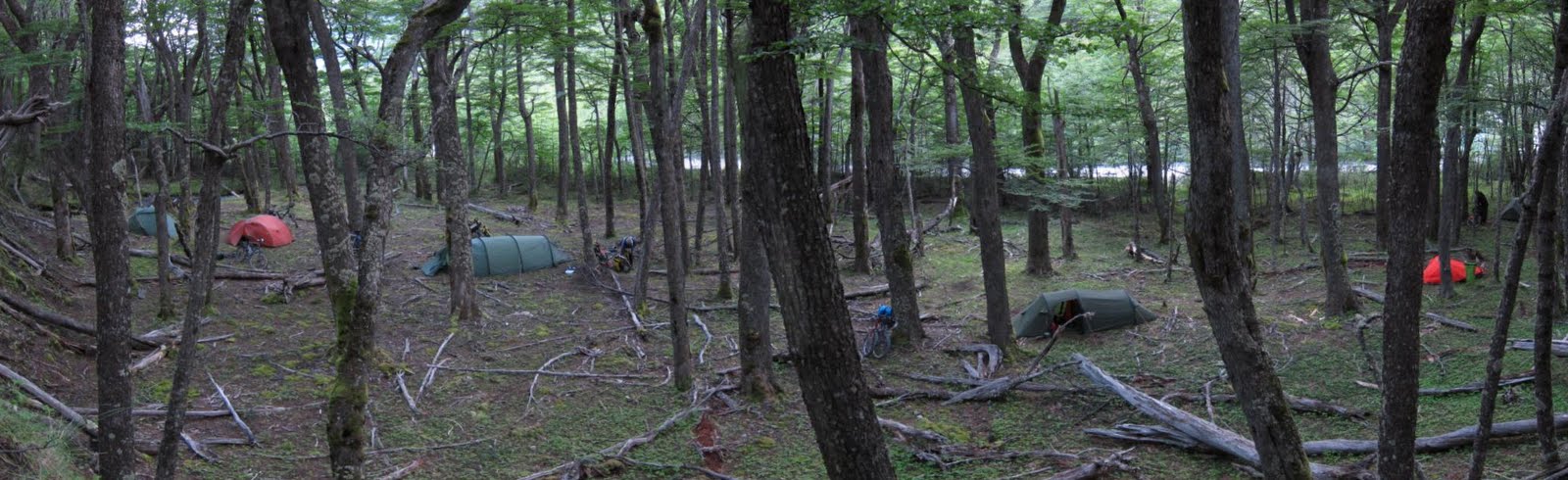
We arrived in Villa O'Higgins, the end of the Carretera Austral, in the pouring rain to find that the boat we'd been planning to get was full. Still, we appreciated the extra rest day and it was probably required to prepare for the infamous (within cycle touring circles at least!) crossing over the boarder to El Chalten. This involved 2 boat trips (the first via the magnificent O'Higgins Glacier) and a 22km bike/hike of which about 7km were mostly pushing through muddy singletrack, over streams and fallen trees. Fun, but quite tiring! We opted to get a horse to take our panniers which made it all more manageable. The crossing acts as a bit of a bottleneck for cycle tourists as the boats aren't frequent, or reliable. As it turned out there must have been about 20 cyclists on the final boat across Lago Desierto. It was great to bump into people who'd met people we'd met, and to exchange stories of travels so far. That night we wild camped in a forest with about 10 other bikers.
Wild camping in the woods

Marion with our canine companion
on the way to Torres del Paine
From El Chalten we turned into normal tourists for a couple of days. Time is running out and we've had to take a couple of buses to make sure we get to Ushuaia for our flight! We bussed to Cerro Castillo on the Chile/Argentine border near Torres del Paine (via El Calafate for a day trip to the Perito Moreno glacier). Torres del Paine is most famous for it's hiking trails around the Paine massif, but due to a lack of any suitable hiking equipment, and time, we'd decided we would cycle through the park to Puerto Natales. It was a wonderful few day's riding, though I think we both enjoyed the days to and from the park more than days in the park! Having spent most of the last month in an area of Chile pretty much untouched by tourists, it was a bit unsettling to suddenly be surrounded by gap-year kids and English speaking people everywhere. The ride into the park was especially wonderful as we were joined by a Swiss couple, and an incredibly energetic dog who ran alongside us for 50km!

Another bus took us here to Punta Arenas, but that will (baring any unforseen problems!) be the last. Tomorrow we head out into the barren plains of Tierra del Fuego for the last week's cycling of the trip. sob.
The boat to Porvenir

Saturday, 22 January 2011

Puerto Bertrand to Villa O'Higgins

We had a tough journey into Cochrane (pronounced Cock-rainy), after lunch in pretty Puerto Bertrand, as the road rollercoastered sharply up then sharply down again with pretty loose terrain forcing us off our bikes for short pushes on a handful of occasions. Despite this we made good time but unfortunately it took it's toll on Pob's old knee injury so we decided to take a rest day. On our day off at Cochrane's Internet cafe (no wifi in town) we met a bunch of cyclists and worked out that there must be at least a dozen cycle tourers in town that day. We picked the brains of those travelling north about different route options to Ushuaia, and made arrangements to travel south the following day with Henry, a Londoner originally from Slovenia. The town itself is fairly small and nondescript, but it's population of around 3000 people makes it the southern hub of the Carretera Austral. The main highlight for us was the best ever Lomo a lo Pobre (which translates as either Poor man's steak or Pob's fave chilean steak dish) of large steak with 2 fried eggs, chips and fried onions at Ada's restaurant, just Northwest of the main plaza, if you're ever in the area...

The following day we set off with Henry, and also Jens, a German staying at Henry's hostel. They were heading down the Carratera to Puerto Yunguay, while we planned to detour off to Caleta Tortel. Also we planned to do it in 3x40km days, whilst they wanted to get to Yunguay (a similar total distance) in 2 days. So when we found nice wild camp spot mid-afternoon, they went on to make the most of the tailwind. It soon started raining so we were glad to have stopped, and cooked in the tent vestibule.

The rainfall only briefly paused between about 9.30 and 11am the following morning, so the next day's cycling was tough. As Pob's knee still wasn't in top form, my bike now carries the tent, which was extra heavy from all the rain. We met 3 pairs of cyclists heading north and each time we quizzed them, in the increaingly heavy rain, about how far it was to the junction off to Tortel - they had all come direct from Puerto Yunguay that day. By this time, completely soaked through - including supposedly waterproof gloves and jackets, both Pob and I were dreaming of a warm hostel bed in Tortel, drying off our cycling clothes, tent and most of all, our sopping shoes. So we decided to go for PB of ripio distance. What should have been a very pretty ride was somewhat marred by some serious rain in the late afternoon, and the countless waterfalls lost their appeal, but ~48miles later, we made it.

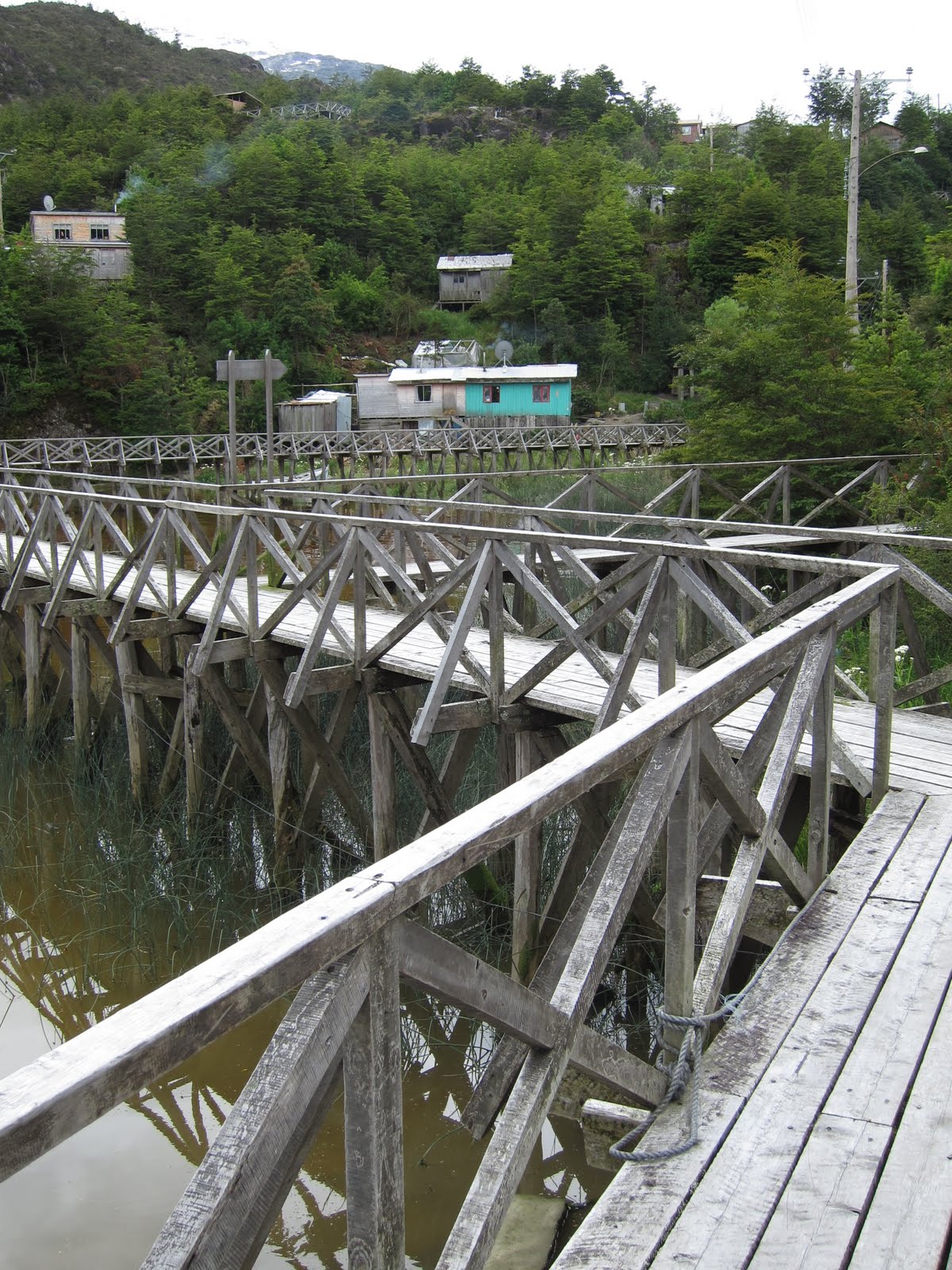
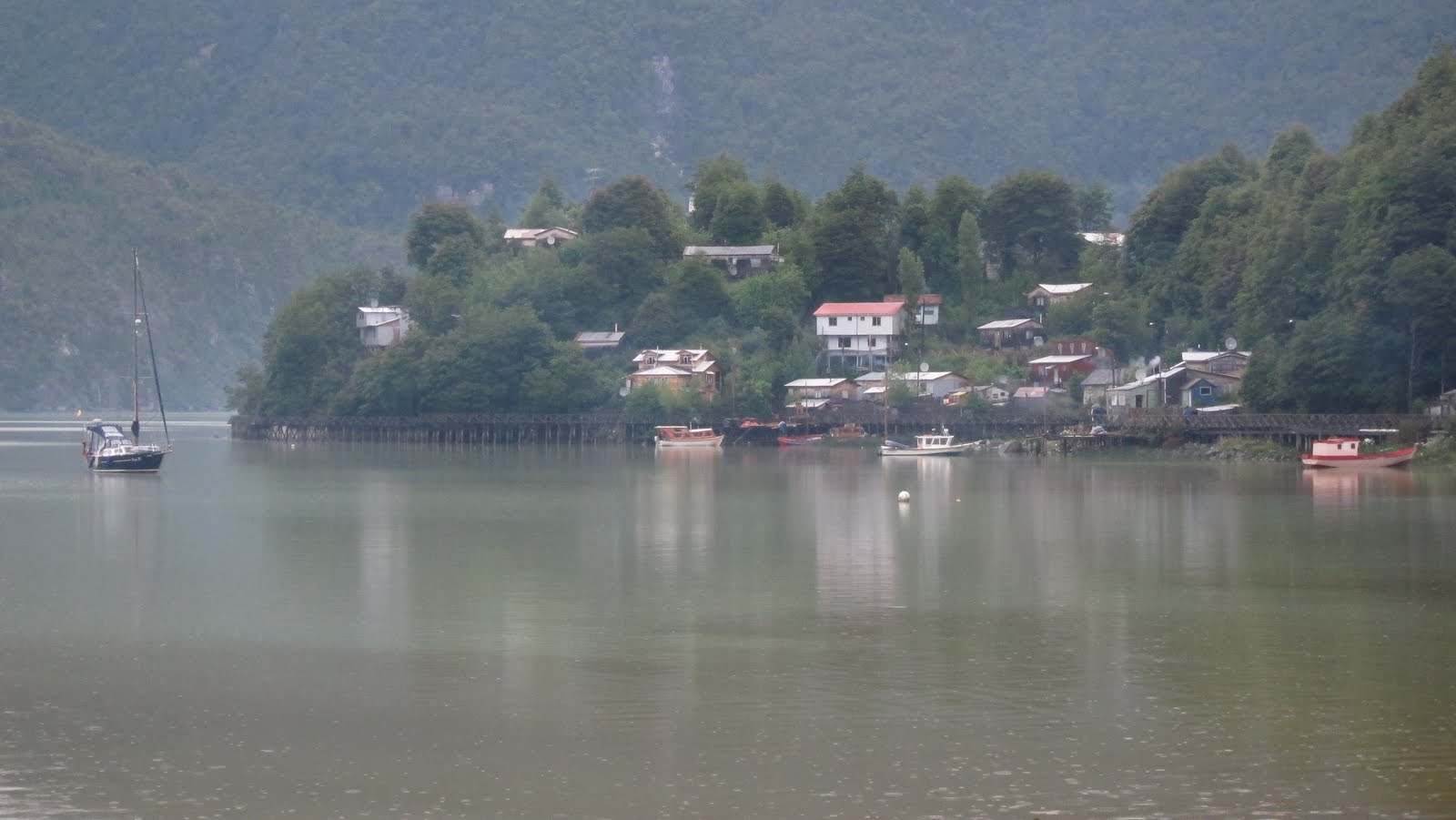
The road to Tortel was built in 2003, previously only accessible by boat. As I hope the pictures show, there are no roads, just boardwalks like jetties from the sea that they built too far inland. With steep hillside it also has a lot of steps, making it less bike-friendly, but we found our warm hostel at the top just 9 steps up from the carpark at the entrance. We felt we deserved another rest day so had plenty time to explore, despite several more downpours. We also decided to skip the long steep hill from the Tortel turnoff to Puerto Yungay, and luckily there is a bus on Thursday - not just the Sunday bus mentioned in the guidebook. This was a big decision as we haven't taken the bikes on a bus since our pampas-avoidance between Tununyan and Villa Pehuenia in the northern lakes.

Official Refugio at Rio Bravo
From Puerto Yungay we boarded the free 45min ferry to Rio Bravo. This crossing is part of the Carratera Austral, but as the amount of traffic is fairly small, it is apparently cheaper for the government to operate the ferry, in a very nice boat, 3 times a day in summer, than it would be to bridge the crossing. We arrived at Rio Bravo at 6.45pm and it was still pouring with rain, but to our delight, there is a shiny new Refugio so we had a free roof over our head for the night, along with Marten and Ari, 2 Dutch cyclists also heading south.


Unofficial Refugio 25km from Villa O'Higgins
This morning we had plans to split the final 100km stretch to Villa O'Higgins into 2 days. We started relatively early for us (9.30) and were quickly outclassed by Marten and Ari who zoomed off ahead. The weather was much improved and several times today I had a shadow, but we had a lot of gentle rain. We also had a very welcome tail wind. At 2.30 we'd already covered about 50km so we considered beating our recent ripio PB and making a push for the Saturday ferry at O'Higgins (previously we'd planned for the Monday boat). The tailwind stayed with us but the rain picked up again. We met Swinde, a German cyclist heading south, at kilometre 75 who helpfully informed us that the Saturday boat had been delayed due to bad weather, and that hostels in O'Higgins are quite pricey. So, I am typing this to you from a half built, but dry, hut at km 75 and the last 25km of the Carratera Austral will have to wait until tomorrow.

Saturday, 15 January 2011

The road along the lake

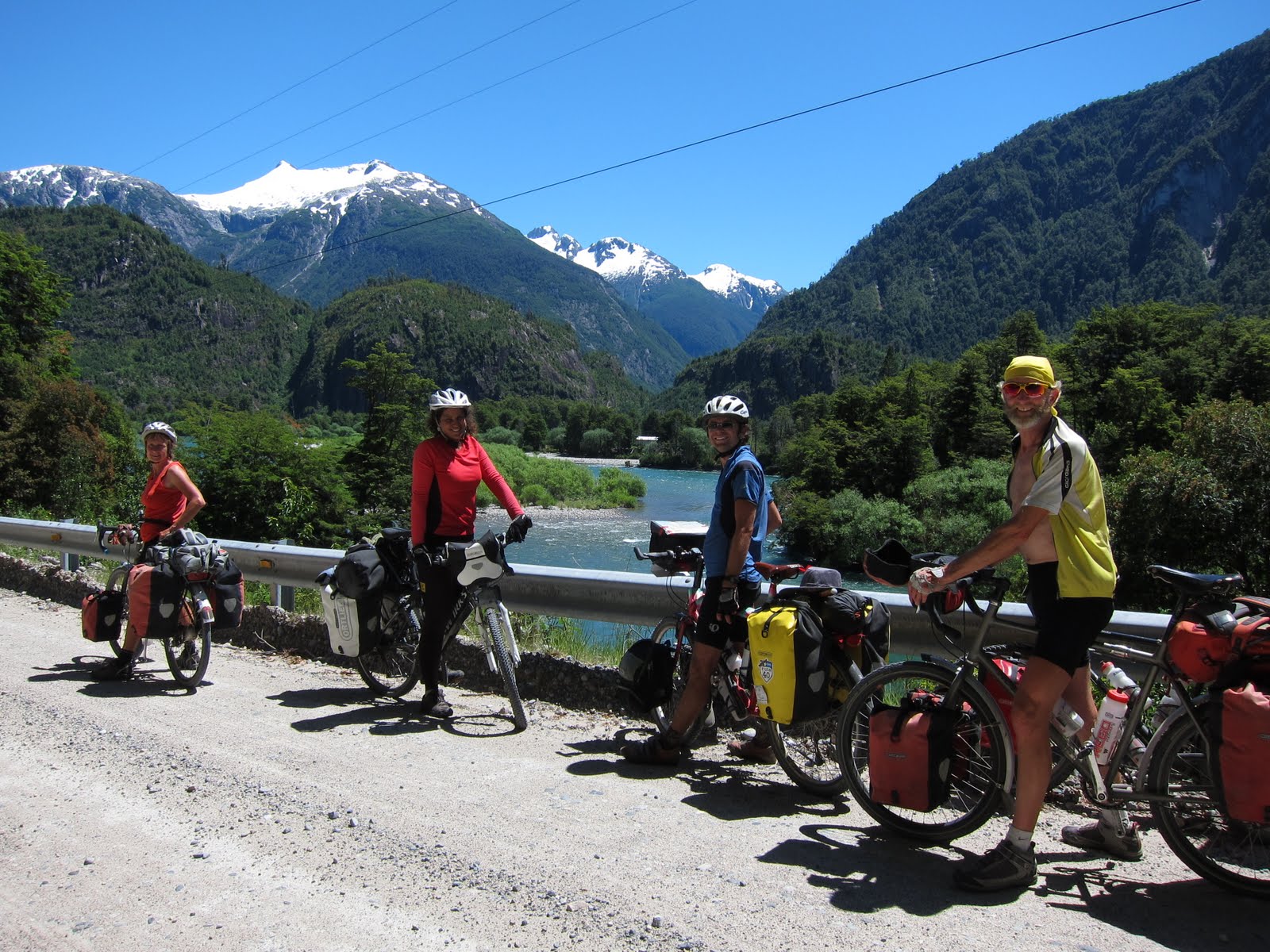
This area of Chile is just incredible. Every day we seem to see more amazing mountains, glaciers, lakes, cliffs, rivers and waterfalls than I've ever seen in one country. The other day we were looking at a pretty anonymous cliff and saying how, if it were transported to the UK, it alone would attract more tourists than Cheddar Gorge. It's even more amazing to think that we're only seeing the parts visible from the road.


Big view, little Marion
We'd heard a lot of great stories about the road along the south of Lago General Carrera. It's described in the Lonely Planet as "Scary and stunning, it hits blind corners and steep inclines high above the lake with no guardrails." Being the optimists we are, the version in our head simply read "Stunning, high above the lake". Other people have described it as the highlight of  cycling in this area, so we took a detour from the Carretera Austral (which follows a northerly route around the lake) and got a ferry over to Chile Chico on the southern shore. After a rest day in Chile Chico to psyche ourselves up, we set off west; a 120km stretch before rejoining the Carretera Austral on the south west corner of the lake. The other issue with the road, which I failed to mention before, is the wind. The prevailing wind is from the northwest, and the road heads pretty much due west. Additionally the lake accelerates the wind towards the southern shore and, where the lake narrows, the wind is often above 60km/h. We figured so long as we were prepared for the worst, it would be fine! And it was. The road was everything it had been described to be. There were sections too steep to ride, sections where the washboarding went on and on and almost shook us to pieces, and sections where the wind literally pushed us backwards as we stood in the gravel holding the bikes (with brakes on!) . But around every corner we were stopping at yet another fantastic view. The lake is an unreal turquoise and the mountains on the northern shore seem to be cut out of card. Maybe you'll get a little of that from the photos.

Along the way we had a couple of nights camping, both with company. The first night we were accompanied by 2 dogs, about 5 hens, 5 chicks and a rabbit. The second night we camped in what looked like an empty field, and got woken at 6 by the sound of sheep surrounding the tent. Both nights we also had the company of hundreds of earwigs. I think we've finally got them out of the panniers now.

Writing this post, outside our cabin.
I'm writing this from a small lakeside village called Puerto Guadal [though it was posted from Cochrane where we found internet access for the first time in a week] which is only 10km from the junction with the main road, so we're pretty much there! Tonight we've treated ourselves to a night in a luxurious cabana next to the beach. After 6 nights camping on the trot, and the last 2 without showers, I think we deserve it!

Touring notes - Carretera Austral Part II

Today's post is brought to you from picturesque Puerto Ingeniero Ibanez, while waiting for the ferry to Chile Chico. We are having so much fun on the Carretera Austral and I wanted to write about some of my misconceptions of this route.

I knew it would be beautiful but hadn't realised how accessible it is. This may be heavily influenced by the fact we have just completed a long asphalt section - possibly our last stretch of paving until we get home... There are several other cyclists heading our way and a few brave ones heading north against prevailing winds which has made for some great chat whilst on the road and off. The road is steadily becoming more and more paved which may mean future cyclists have to struggle with more zooming traffic and also takes away from the natural beauty of the place. However, flat road allows you to concentrate more on the view and less on how to tackle the sandier, pebblier bits of ripio.

Simple things like the availability of fresh tomatoes and perfectly ripe avocados have improved our lunch repertoire - along with our fellow cyclists proving that it is possible to carry such things for a couple of days without making a mess of the inside of a pannier.

We have been incredibly lucky with the weather - we still haven't had to cycle in any appreciable amount of rain (Superstitious readers may be interested to know my wrists are leaning on a wooden table). Quelet National Park that Pob mentioned in his last post gets 4000mm rain/year but we have lovely warm sunshine.

I was quite worried about horseflies here, and they are EVERYWHERE, but they're much easier to deal with than mozzies. They don't torture you at night when you're trying to sleep, they're big so easy to see and quite slow so satisfyingly easy to squash. Oddly they like to bite you through your clothes not straight through your skin so covering up doesn't help. Another cyclist described it like a dance which I think is exactly right - just imagine the Macarena playing then: Hit left shoulder, hit right shoulder, hit left hip, hit right hip, clap, jump about a bit and yelp when you squash one. Repeat to fade.

Saturday, 1 January 2011

Happy New Year!

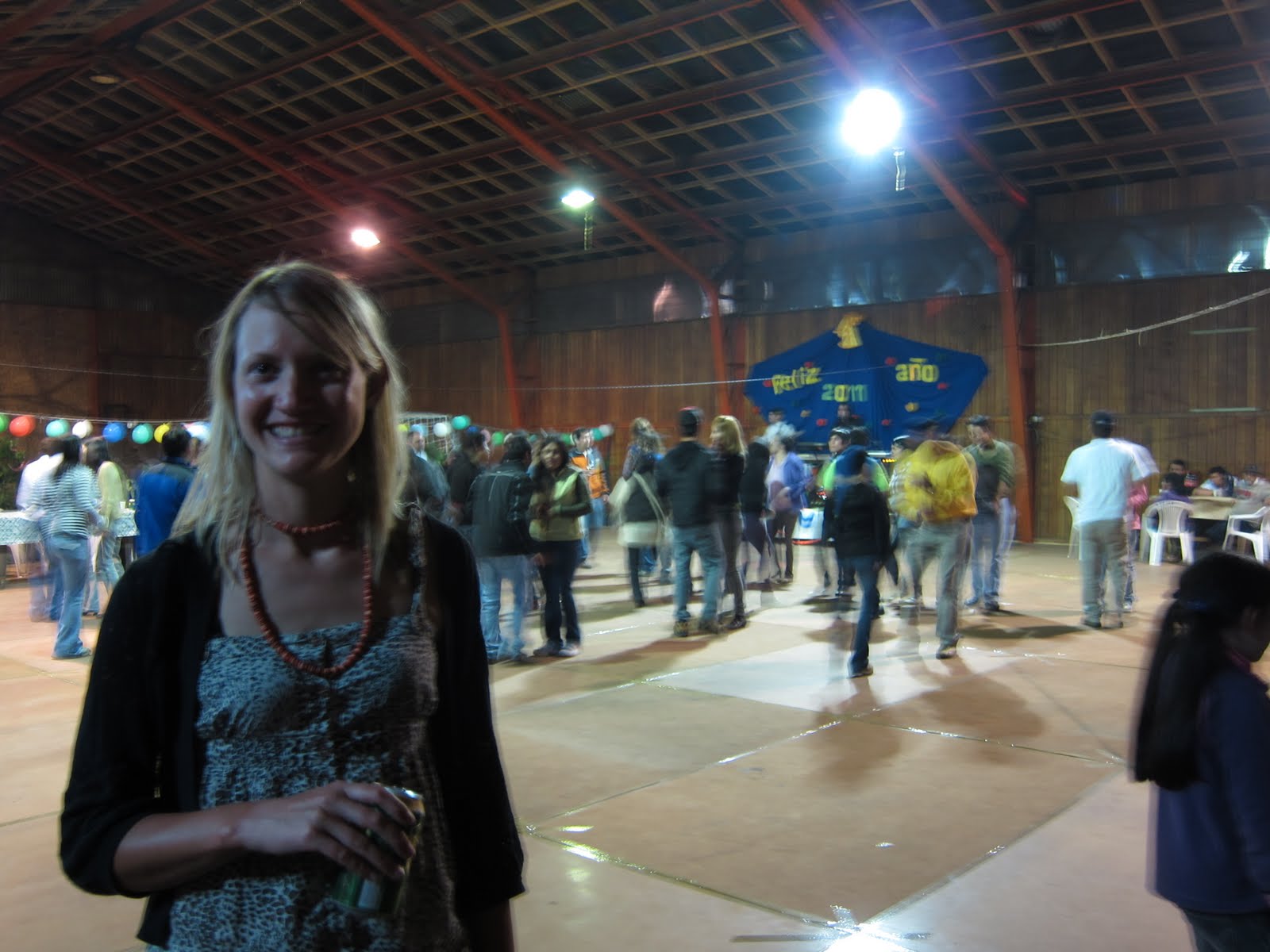
We have our first proper hangover of the trip, which I guess in a way is a good thing! We went out for a lovely meal last night with Hugh and Pauline, followed by a disco in the gymnasium, where Marion danced with pretty much every one of the local bachelors....

We're in the tiny fishing village of Puerto Puyuhuapi in the Queulat National Park where we spent last night in a small campsite with 7 other cycle tourists all heading down the Carretera Austral! Today we're off to see a hanging glacier, and generally taking it easy.

Happy New Year everyone!

Thursday, 30 December 2010

Finally on the Carretera Austral

2 posts in one day?! This may become a more common occurrence as we come across WiFi less and less frequently.

We are now in La Junta, a small town on the Carretera Austral in Chile. This is the road which we will take for the next 900km south. If the first few days are anything to go by then its going to be quite a trip! We left the small welsh town of Trevelin on the 27th, with company! We happened to be staying in the same hostel as an English couple, Hugh and Pauline, and an Austrian, Nadja. They had met a few days previously and were heading in the same direction as us, so we joined them. It's lovely to have some company from home and to be with English speaking people for the first decent amount of time since Lou left us in November!

From Trevelin we went over the border to Futaleufu in Chile were we had an early birthday celebration meal out, it was going to be camping the following night! I then rode the next few day with a decorated bike, courtesy of Marion's birthday presents.

Since then we've had a couple of nights wild camping in the most stunning scenery. It's been incredibly hot, and dry which would be unbearable were it not for frequent lakes, streams and rivers to refill water bottles and cool off in. We'd heard that this road was going to be spectacular and so far it's more than lived up to its reputation. So long as we manage to keep stocked up with pasta sauce and tuna all should be fine. Tonight though, we shall be finding some proper food.

Friday, 24 December 2010

Wine!

This is a little out of sync, but I need to brain-dump and Pob will shortly be posting some more up to date details of our trip.

I like the Argentinian way of life, but apparently in Argentina the adults drink more fizzy drinks than they do wine. This is not something Pob and I have been trying to emulate over the last few months.

The following grape growing info comes with a big health warning - most of it was gleaned from poorly understood bodega (vineyard) tours in Spanish or occasionally pretty sketchy English. Also, it's taken me a while to get round to writing this but maybe that means this will be the mature, concentrated version.

Wine growing guide
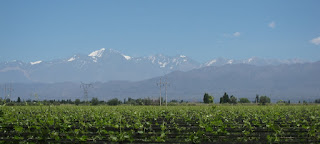
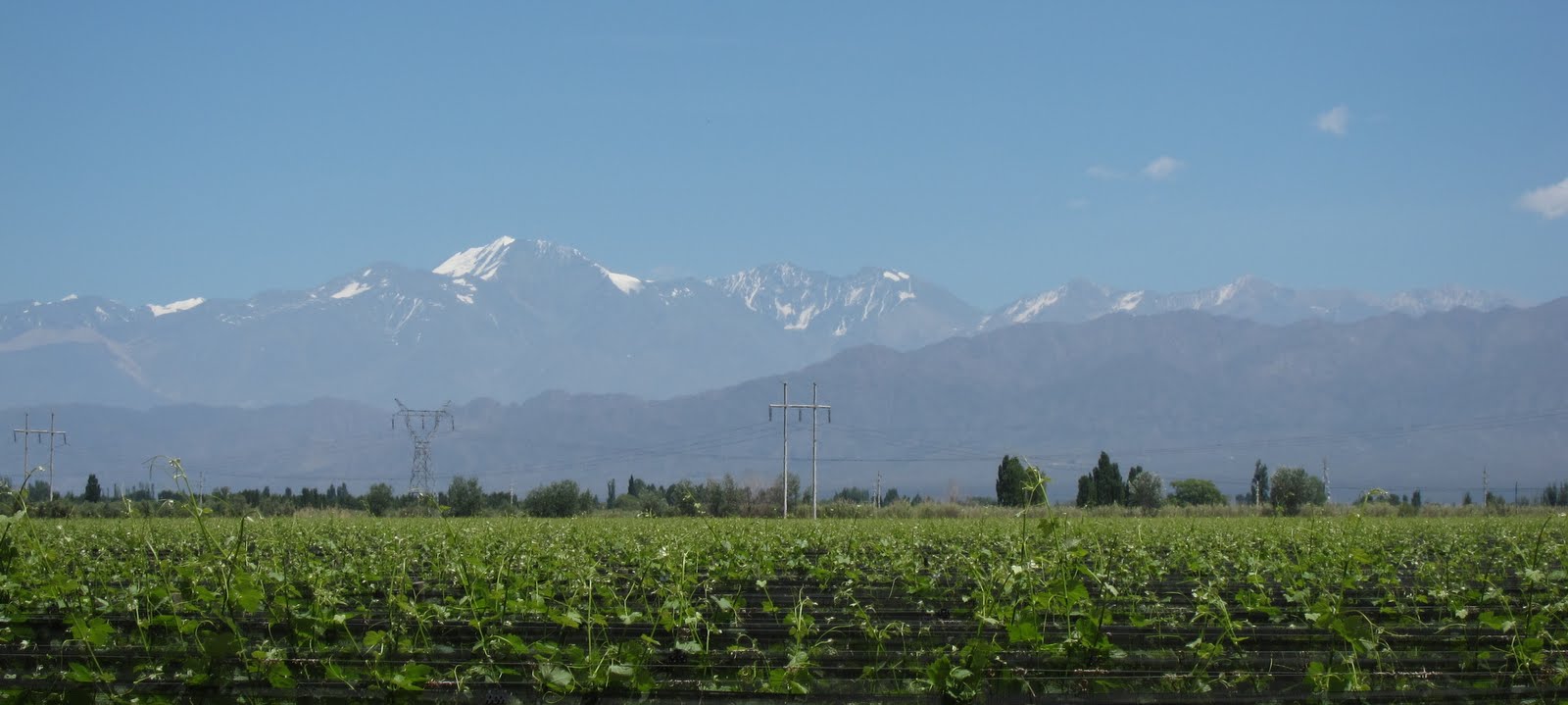
Start with lots of sunshine which you can maximise by planting your grapes in East-West orientation for all-day exposure. This apparently makes the skin thicker (the grapes' way of making their own sunblock) and more skin means more flavour from tannins and such.

Start with a dry atmosphere (high altitude helps), with minimal rainfall but readily available water from snow melt. This allows you to vary watering during the growing season - limiting it before harvest to concentrate the juice and who wants watery wine?

For organic grapes, a sunnier, drier atmosphere means you'll have far fewer pests. Lavendar is useful because bugs like it more than they like grapes. Also plant roses as a disease warning system because they're much more sensitive than vines are, acting a bit like canaries for miners.

Apparently birds don't like grapes but you may want to use nets to protect your fruit from hail stones.
To go one better than organic grapes, why not try biodynamic techniques? One bodega testing this out explained they were timing pruning and harvesting by the phases of the moon. The theory is to prune during new moon, when gravitational pull keeps all the nutrients in the roots, then harvest at full moon so maximal gravity draws the goodies to the grapes. Unfortunately the grapes are still a couple of years off being certified so there's no wine to try yet.

Even once the biodynamic stuff is certified, it might not be really good for decades because wine is said to be better from vines-of-a-certain-age. The average plant can last ~150 yrs and I seem to remember the best years are 80-110 years old. In another bodega we were told you can achieve the mature vine effect simply by taking a cutting from an older vine so the new vine is a clone of the old. This will not only start producing great grapes straight away but also last ~150 years. Sounds too good to be true to me - I don't know why everyone doesn't do it.

In the Southern hemisphere the harvest usually happens in February or March. However for a 'tarde' desert wine, the grapes are allowed to mature on the vine for longer increasing their sugar content.

When harvesting, make sure the grapes don't burst because this would start fermentation. Warmer (and therefore faster) fermentation should be avoided unless you want cheap plonk. Many bodegas control fermenting temperatures with cellars, or refrigerated tanks but we visited one champagnery that ferments the grapes in a cave!
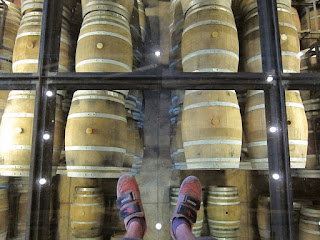
To start fermentation you need to mulch the grapes. Most wines don't need added yeast because it exists naturally on the grapes themselves. Remove the bits (seeds and skin) straight away for white, remove afer a day for rose, or a couple of weeks later for red. After fermentation you leave the juice in a tank for several weeks to develop.. By this stage you could bottle your young wine now, or if you think your grapes are up to it and you want a better (more pricey, longer lasting) wine, move it to oak barrels. The barrels should be made from French or American oak, each of which imparts distinctive flavours to the wine through tannins. American oak is cheaper, imparting flavour faster and tends to provide notes of tropical fruits or vanilla, while French oak takes longer but is said to be of higher quality providing aromas like chocolate, coffee, mushrooms and tobacco.

While the wine is in the barrel some will evaporate, concentrating the flavours and upping the alcohol content. The tannins from the barrel also act as a preservative. Grape skins also contain tannins although the amount depends of the grape variety. This means that wines made from Cabernet Sauvignon, which is full of tannins, last longer than Malbecs, which have hardly any. Also, since white wines are separated from their skins right at the start, they just don't last as long as reds.

Wines oaked for a long time (e.g. 2 years) are more flavourful, alcoholic and can be kept for years longer, improving with time - up to a point. Natural cork also adds preservatives and flavour (although I gather this is controversial) and if using natural corks you should leaving the bottles on their side in a cool dry place for a few months. If you happen to have a spare 19th century fermentation tank, this would be ideal.
Next step - drink it!

Fake Wales and Real Whales

We've just got back from the Peninsula Valdes where we spent 4 days in the sun wildlife spotting. We stayed in the only village on the peninsula, Puerto Piramides, in an eco-hostel. The hot water was solar heated and the grey water was recycled for toilets. Good stuff, though we did have to endure a couple of brief power cuts (one in the middle of cooking) and a few hours without water.

The peninsula is home to (among many other arguably less interesting animals..): Sea lions, elephant seals, killer whales, Magallenic penguins and Southern Right whales. We hadn't expected to be able to see the whales as they tend to leave the area in mid December. However, when we arrived we heard that there were still a group of whales in the bay, so we jumped on the first boat available and went to have a look. We were lucky enough to see a mother with her newborn, helping it to swim, along with at least 5 other whales. It was incredible to see such huge mammals moving so gracefully through the water, and swimming right up to and under the boat. The photos don't do it justice. If you ever get the chance to go whale watching, you have to do it!

We hired a car and drove round the peninsula to see the other animals including a huge colony of sea lions and seals in the north (where we unfortunately missed killer-whale-feeding-time, though did spot their dorsal fins patrolling the shore).

On the final day we drove down south of the peninsula to Punta Tombo, where there is the largest continental colony of Magellanic penguins. The penguins are unbelievably curious and confident so you can get right up close to them. They're very cute and entertaining to watch (Marion couldn't stop smiling all day). It's nesting season so we got to see some very young pingus too.

We'd planned to spend the final afternoon drinking Welsh tea in the small welsh settlement Gaiman, but ran out of time. Fortunately, this whole area of Patagonia has a scattering of Welsh villages and on boxing day well be heading to Trevelin so the tea will have to wait until then!

We're now back in Esquel where we'll be spending Christmas before continuing the journey south. Happy Christmas everyone!

Sunday, 19 December 2010

In Patagonia

Hello from the middle of Parque Nacional Los Alerces, named after some very old very slow growing trees which the park aims to protect. It's pretty remote here, so obviously no wifi and I'll post this in a couple of days...

The park was founded by Aled Jones (not that one) suggesting we're approaching the parts of Patagonia that the Welsh inhabit. We've been cycling through some truly beautiful scenery, but with some pretty irritating rocky sandy ripio. We're covering about 25-30 miles a day cycling for about 4 hours a day. I expect we could go further but we're both pretty tired by the end of the day.

Over the last week we've seen far more rain than for the previous 2 months, and to get us in the Christmas mood we've also cycled through snow and hail. We've also experienced some Patagonian wind - one tailwind helped Pob top 44mph, (assisted by a steep hill and the slipstream of a lorry).

We treated ourselves to a night in a very fancy hotel, that happened to coincide with constant rain, so we felt obliged to enjoy the respite from the weather for an extra night. Fog meant we didn't get to appreciate the views fully until our second morning when it cleared up revealing the previous night's snow.

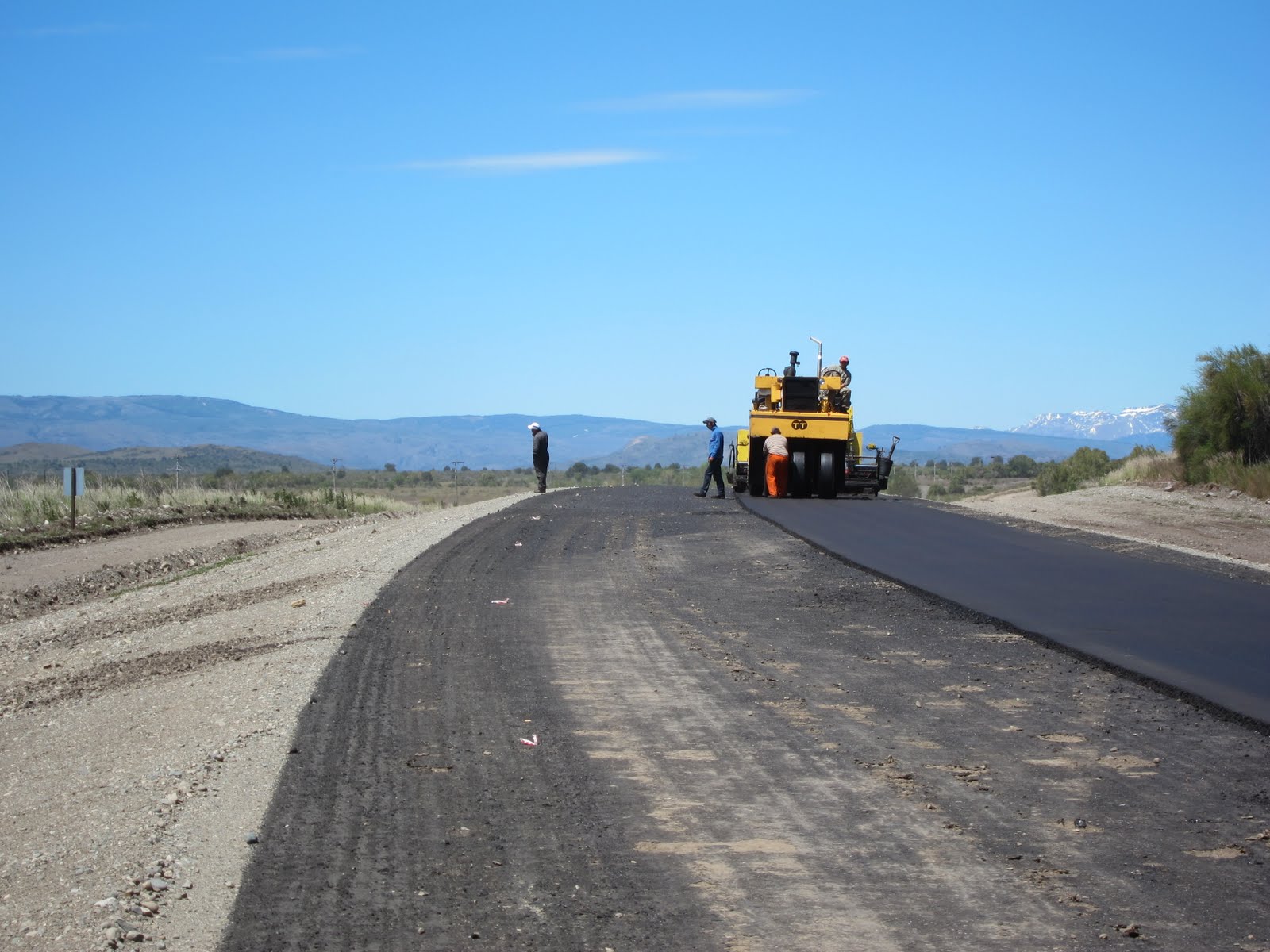
Yesterday we passed through Cholila, a pueblo famous because Butch Cassidy alledgedly holed up here after fleeing Mexico. Most of the way was ripio, but with a section of freshly paved road. Unfortunately it was a bit too fresh, as I discovered after stepping onto the side of the road, then spending the next 20 minutes picking the tar out of the clips in the bottom of my shoes. I was terrified it might dry with me clipped into my peddles, but we got almost all of it out, and if anything it's added a bit of lubricant so clipping out is easier than ever.

We've found our Christmas accommodation in a pine forest just west of Esquel (I love this map). It's unseasonably cold, which is helping with the Christmas feeling, but we're off on a trip to the sunny east coast before then to a national park famous for it's marine life, sea lions, penguins, maybe whales. Photos to follow...

Tuesday, 7 December 2010

The meditative effects of ripio

I've found a new technique to handling sandy rocky hilly roads that I wanted to record (and share with anyone who's interested).
I had a breakthrough with ripio today, but I should explain - I'm fairly new to mountain biking. I first had a go about 18 months go in the English Lakes with Pob and Alistair, who will both back-up that I was not a natural. Part of the problem was that the hired bike was pretty rubbish, and specifically that it had a seriously uncomfortable man's seat. These days I've learnt to appreciate that what padded shorts lack in style they more than make up for in comfort and, now we've done more than 1000 miles, my classy leather saddle ought officially to be moulded to my shape. However - this is not my breakthrough.

Argentina tends to categorise its roads as either pavimiento (paved), consolidado (packed dirt - often brown, occasionally yellow or brick red depending on the soil, fairly flat and not too troublesome), or ripio (sand, gravel, rocks, pebbles or some combination of the above). We finished the seven lakes route today which is very beautiful (see photos) but the roads were variable and the whole lot was very hilly. Uphill ripio requires total concentration - you skid or slide about half a dozen times with each rotation of the wheel, and it can be a lot better or a lot worse depending on which section of the road you choose. This requires total concentration and starts the zen-like process, clearing your mind of all other thoughts.
The end of the ripio!!
Maximum meditation however occurs on downhill ripio. Pob disagrees with me on this one and says he felt most comfortable today whilst owning downhill ripio, skiing style. In my view, possession doesn't come into the ripio equation and it's more about an acceptance that the combination of you, your bike and the ripio will get you where you need to be. There are moments while zooming down steep ripio when I feel braking will be dangerous, or I'm following the wrong line with tons of rocks in the way each trying to send my bike off course. My big breakthrough was a subconscious acceptance that bikes basically want to go in a straight line whatever rocks you bounce over (just check out those dudes who ride with no hands on their handle bars). The other major factor in making me chill out and relax a bit is that the only suspension my bike has comes from my knees and elbows - so the rest of my gets the smoothest ride when they're in zen-mode.

So that's ripio meditation for you. I'm also preparing a post on wine (with pretty pictures) but that can wait for now. Good night all.


Wednesday, 1 December 2010

Welcome to Patagonia

Lakes are meant to be calm!
We're in Patagonia! And for the last couple of days we've been getting the traditional Patagonian welcome. Wind. I've decided that I prefer hills to wind. Hills are marked on a map, they're predictable when you're on them, and they're much quieter. Yesterday we covered 25 miles in about 7 hours. The road was awful and there was quite a bit of uphill, but the real problem was the 35mph head wind which slowed us to walking pace for most of the day. It can turn what should be a pleasant, short ride into a long and hard day. This morning we experienced the flip side as we had the wind behind us as we cycled from our lovely, sheltered, campsite at Lago Lolog to San Martin de Los Andes. We had planned to be here by lunch and got here in time for coffee. It doesn't mean I've forgiven the wind for yesterday though.
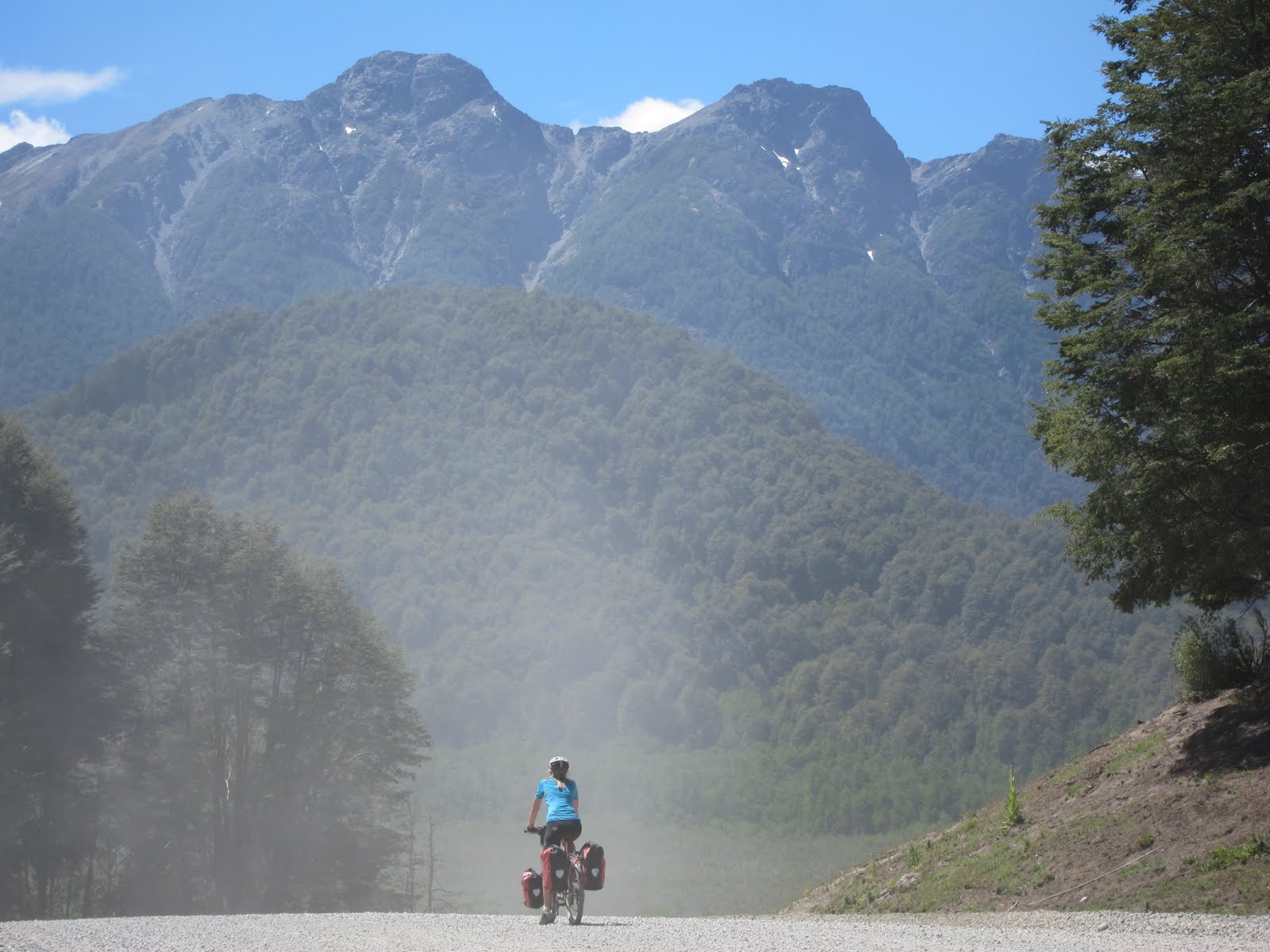
The view from bed in Villa Pehuenia
We're now in the heart of the Argentine Lake District, which is definately the most beautiful area of Argentina we've seen so far. Since the last post we cycled through the famous (in the world of wine...) Uco Valley in Mendoza, spending a few days in a small town called Tupungato where we had a couple of wonderful gourmet meals at vineyards. We then caught a bus down to the lakes, via Zapala to Villa Pehuenia, a small village in the quiet northern region of the district, on the bank of Lago Alumine. We arrived late and the hostel we planned to stay in was full so we ended up a place nearby called Posada la Escondida. It was the most incredible hotel we've stayed in - the kind of place where they make your bed in the morning, then re-make it (for sleeping, with chocolates and candles) while you're having your evening meal. Mental. Our room was a couple of metres from the lake so we had the most wonderful view from bed; so great I actually got up at 6:30 to take photos.

A typical road through the lake district
 (sometimes there are lakes too)
Since then we've done quite a bit of camping (our way of paying off the hotel bill...), including our first night wild camping next to the Alumine river. We spent a couple of nights in the 'trout fishing capital' Junin de Los Andes, where we tried our hand at fly fishing. Unfortunately the trout are protected so I had to throw back the one I caught, but we got to keep the perch that Marion caught. The restaurants there will cook your fish for you, so we went to a lovely place on the plaza, perch in a plastic bag, and they served it up with garlic chips and a bottle of wine. mmmm.

We're going to stay a day here in San Martin before heading down La Ruta de Siete Lagos (route of 7 lakes). This is a 3-day ride through apparently some of the best scenery in the lake district. It should be wonderful, but at the moment we're just praying for the wind to stop!

Sunday, 14 November 2010

Our wine tasting holiday

It's been a while since we last posted. Our excuse is that we were hoping to bring you a guest author, but she never quite got round to writing anything and has now left us for Guatemala.

The stars from Leoncito Observatory
As you'll be able to see from the map and photos, we've been quite busy for the last few weeks - though haven't done a great deal of cycling. We have seen the stars from an Argentine observatory, visited Cordoba, met up with Lou, toured about 12 vineyards in San Juan and Mendoza (and tasted countless wines), ridden through El Zonda (not fun), done a couple of Spanish classes, gone to Chile, been to the beach, and lost a camera.


One of many oaking rooms!
We're now back in Mendoza having bussed over the Andes this morning. The camera has been replaced and I'm just waiting to hear how much of the crazy Chilean camera price my insurance will cover. As well as being back in Argentina, we're back on our own again after almost 2 weeks with Lou's wonderful company!

As she joined us for the Mendoza period we, unsurprisingly, spent most of our 'holiday' time visiting vineyards and tasting wine. The vineyards around Mendoza are just amazing. We spent a few days in Maipu, a small suburb of Mendoza where there are 30+ bodegas (vineyards). A typical visit involves a short tour of the bodega, with an explanation of how the wines are made and how their specific processes or techniques differ from those of other bodegas, followed by a tasting where you may get anything from 1-5 wines (sometimes for free). We've been learning everything from the different effect French oak has on the flavour vs American oak, to the optimum direction in which to plant the vines. It's definitely given us a flavour for good wine though I still don't think I can always pick the malbec from the cab sauv. More practice is required.

The beach at Vina del Mar
After a few days in Mendoza we headed over to Chile where we left Lou to get her plane from Santiago. Marion and I then headed for the beach at Viña del Mar and Valparaiso. It was great to see the sea and the wonderfully creative street art in Valparaiso. Unfortunately the Pacific around there at this time of year is very cold so there was no swimming, but we got a good dose of sun and sand.

Tomorrow we're going to try to sort out the next part of the trip: a few days in the Uco valley for some more wine tasting, before we head south for a change of scenery (and temperature) in the Lake District.

Marion and Valparaiso graffiti

Friday, 29 October 2010

Stranded

It's Tuesday and we're stuck in a fancy hotel in the middle of scrubland. We've got practically our 1st views of the snow capped Andes - but the mountains are some distance away.

We cycled 10 miles yesterday, incredibly gently, from incredibly windy Rodeo. Pob's knee is still grissly despite throwing our precious bikes around in the bottom of a few buses and 2 days enforced bed-rest in Rodeo after a poisonous ham and cheese pizza.

There are worse places to be stuck. The hotel is built around an indoor thermal bath complex - fluffy white dressing gowns, optional treatments, that kind of thing. The smart restaurant serves fittingly health-conscious food, but you can still get a greasy steak if you ask nicely. It costs about 5 times as much as our usual hostel, but thankfully they take credit cards, especially important because yesterday the Rodeo cashpoint was out of cash.

The next town is 25 miles away - currently unbikable but with buses leaving daily at 4am. We'd just got our heads round this to book tickets when the concierge remembered that it's a national holiday tomorrow, for the national census, so there's no bus til Thursday. So two more days of lazing about for us. Hopefully some supporting thermal water will do Pob's knee some good.